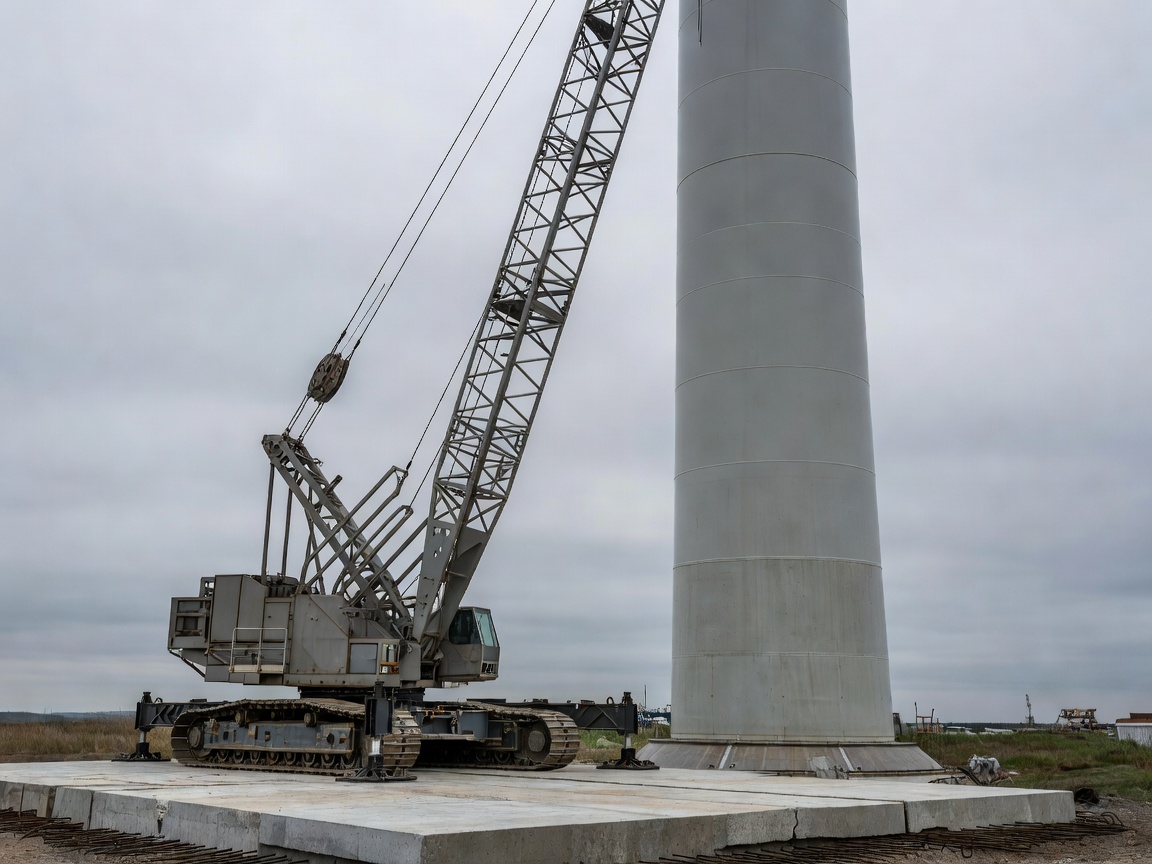
 Figure 4: Heavy crawler crane staging on a civil compacted hardstand pad during a scheduled main bearing exchange campaign.
Preventive Campaign Logistics vs. Reactive Emergency Scrambles
In utility asset stewardship, reactive maintenance is an economic disaster. When a main bearing or transformer fails without warning during a November gale season, electricity spot prices are often at their annual highs, meaning every hour of curtailment carries maximum penalty. Simultaneously, crane access rates skyrocket, and high ground saturation turns site roads into quagmires.
We advocate structured preventive campaign planning. Instead of dispatching single teams across isolated work tickets, intelligent operators batch high-risk interventions into dedicated seasonal campaigns: external blade composite repairs in dry summer months (June–August in Northern Europe), high-voltage switchgear testing during scheduled grid maintenance shutdowns, and gearbox oil flushes during low-wind meteorological windows.
Weather Windows and Metocean Accessibility Thresholds
Every physical intervention on a turbine is governed by environmental physics. The table of limits is non-negotiable for human safety and equipment stability:
- Rope-Access Blade Repairs: Restricted to sustained winds under 10 m/s (∼19 knots), zero precipitation, and air temperature above the dew point for epoxy cross-linking.
- Main Component Crane Lifts: Blade drops or nacelle hoists require calm winds below 7 to 9 m/s at hub height (often 120m+), with zero gust differential across the hoist path.
- Offshore SOV / CTV Stepping: Crew Transfer Vessels (CTVs) typically have safe landing limits of 1.5m significant wave height ($H_s$), whereas advanced Service Operation Vessels (SOVs) with 3D motion-compensated walk-to-work gangways push this threshold up to 2.5m to 3.0m $H_s$.
The Civil Infrastructure Dimension: Hardstands and Access Tracks
Onshore maintenance planning frequently neglects ground mechanics. An 800-tonne telescopic or crawler crane requires a compacted hardstand capable of bearing ground pressures exceeding 250 to 350 kN/m². Maintenance managers must commission civil geotechnical plate-load tests and verify turning radii along forestry and agricultural access roads before mobilizing multi-axle low-loaders.
Spare Parts Strategy: The Consignment vs. Central Hub Dilemma
Wind turbine components do not ship off-the-shelf. Heavy items like forged main shafts, segmented pitch rings, and high-voltage power converters involve lead times ranging from 16 to 48 weeks.
A robust supply chain model establishes a three-tier inventory architecture:
- Tier 1: Up-Tower Consumables: Staged inside tower bases—filters, spare pitch sensors, hydraulic solenoids, fuses, safety lanyards.
- Tier 2: Regional Hub Sub-Assemblies: Shared across 3 to 5 adjacent farms—pre-tested pitch motors, yaw calipers, circuit breaker modules, lightning cards.
- Tier 3: Strategic Strategic Spares: Central national depot—spare low-speed planetary gearboxes, refurbished generator stators, and matched blade sets.
| Logistical Scenario | Key Constraints | Asset Mobilization | Lead Time Requirement |
|---|---|---|---|
| Onshore Minor Service | Internal ladder / service lift certified | 2-person van crew + PPE | 1–3 business days |
| Onshore Blade Shell Repair | Dry weather, ambient > 12°C | Rope-access team + trailer habitat | 2–4 weeks (weather window) |
| Onshore Major Overhaul | Hardstand compaction, bridge permits | 750t crane + 4 axle transport | 6–12 weeks planning |
| Offshore Nacelle Exchange | Metocean swell < 1.5m, wind < 8 m/s | Jack-up vessel (JUV) + SOV fleet | 3–6 months charter lead |
Safety Envelopes, Lock-Out/Tag-Out (LOTO) and GWO Standards
High-altitude maintenance within utility assets combines electrical hazards (690V generator buses and 33kV step-up transformers) with stored kinetic energy (rotor inertia) and gravitational potential. All technicians must hold certified Global Wind Organisation (GWO) credentials covering Working at Heights, First Aid, Manual Handling, Fire Awareness, and Advanced Hub Rescue.
Rigorous Lock-Out/Tag-Out (LOTO) procedures dictate mechanical rotor lock insertion (hydraulic pins engaging the rotor hub disc), hydraulic pressure dumps, and high-voltage breaker earthing prior to any human entry into the hub cavity or drivetrain envelope.